
Behind Every Prescription Is a System: Why Patients Are Asking Smarter Questions About Medicines
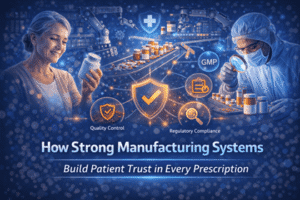
Every prescription represents more than a treatment, it represents trust. Patients trust that the medicine they consume is safe, effective, and manufactured under the highest quality standards. Behind that trust lies a strong pharmaceutical manufacturing system designed to ensure consistency, compliance, and safety at every step.
In this blog, we explore how robust manufacturing systems directly impact patient trust, why quality assurance matters, and how pharmaceutical companies can strengthen confidence through operational excellence.
Why Patient Trust Matters in Healthcare
Trust is the foundation of healthcare. When patients receive a prescription, they expect:
- Accurate dosage and formulation
- Consistent product quality
- Safe ingredients
- Regulatory compliance
- Reliable availability
Any compromise in pharmaceutical manufacturing quality can weaken this trust and impact patient outcomes.
Strong manufacturing systems ensure that every medicine reaching the market meets strict safety and efficacy standards.
The Link Between Manufacturing Systems and Medical Quality
Pharmaceutical manufacturing systems are structured frameworks that govern production processes, quality control, compliance, and documentation. These systems are designed to maintain:
- Batch-to-batch consistency
- Controlled environments
- Standardized procedures
- Traceability across the supply chain
By minimizing variability, manufacturers reduce the risk of defects, contamination, or recalls, all of which directly affect patient confidence.
Key Components of a Strong Pharmaceutical Manufacturing System
1. Good Manufacturing Practices (GMP)
GMP guidelines ensure that medicines are consistently produced and controlled according to quality standards. This includes:
- Clean production environments
- Validated equipment
- Trained personnel
- Proper documentation
Compliance with GMP builds credibility with both regulators and patients.
2. Robust Quality Control and Quality Assurance
Quality control (QC) focuses on testing products, while quality assurance (QA) ensures processes are correctly followed.
Together, they:
- Prevent defective batches
- Detect deviations early
- Maintain regulatory compliance
- Ensure product reliability
This layered approach strengthens pharmaceutical manufacturing quality.
3. Advanced Technology and Automation
Modern pharmaceutical manufacturing increasingly uses:
- Automated production lines
- Real-time monitoring systems
- Data analytics
- AI-driven quality checks
These technologies reduce human error and improve precision, helping ensure every prescription meets exact standards.
4. Supply Chain Transparency and Traceability
A strong manufacturing system extends beyond the factory floor.
Traceability systems allow companies to:
- Track raw materials
- Monitor supplier quality
- Manage inventory efficiently
- Respond quickly to potential issues
Transparent supply chains reinforce reliability and strengthen patient trust.
How Strong Manufacturing Systems Prevent Recalls and Risks
Product recalls can significantly damage brand reputation and public confidence. Robust pharmaceutical manufacturing systems reduce risks by:
- Implementing strict validation processes
- Conducting routine audits
- Monitoring environmental conditions
- Maintaining detailed batch records
Proactive risk management ensures medicines remain safe from development to distribution.
The Role of Regulatory Compliance in Building Confidence
Regulatory bodies establish standards to protect patients. Companies that prioritize compliance demonstrate accountability and responsibility.
Regular inspections, certifications, and adherence to global standards signal that a manufacturer values safety and quality above all.
When patients know their medicines are produced under internationally recognized standards, trust naturally increases.
Digital Transformation and the Future of Pharmaceutical Trust
The future of pharmaceutical manufacturing lies in digital integration. Emerging technologies such as:
- Digital batch records
- Predictive maintenance
- AI-based quality monitoring
- Smart manufacturing systems
are making production more transparent, efficient, and reliable.
As manufacturing systems become more intelligent and data-driven, patient confidence continues to grow.
Beyond Compliance: Building a Culture of Quality
Strong systems alone are not enough, culture matters. Pharmaceutical companies that embed quality into their organizational culture create long-term trust.
This includes:
- Continuous employee training
- Ethical business practices
- Transparent communication
- Commitment to patient safety
When quality becomes a shared responsibility, every prescription reflects that commitment.
Final Thoughts
Every prescription carries an invisible promise, a promise of safety, consistency, and care. Strong pharmaceutical manufacturing systems ensure that the promise is fulfilled.
By combining regulatory compliance, advanced technology, rigorous quality control, and a culture of excellence, manufacturers can build lasting patient trust in every dose delivered.
Because in healthcare, trust is not manufactured overnight, it is built through systems that protect patients at every step.
