
Artificial Intelligence in Pharmaceutical Manufacturing: From Quality Control to Quality Prediction
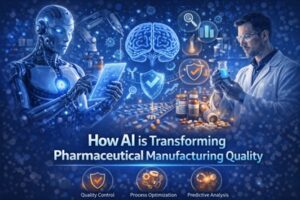
Artificial Intelligence (AI) is rapidly reshaping pharmaceutical manufacturing. In an industry where precision, compliance, and patient safety are non-negotiable, AI is helping manufacturers improve quality control, reduce errors, and streamline production processes.
This blog explores how AI is transforming pharmaceutical manufacturing quality, the technologies driving change, real-world applications, and what the future holds for pharma companies.
Why Quality Matters in Pharmaceutical Manufacturing
Pharmaceutical manufacturing quality directly impacts patient safety, regulatory compliance, and brand trust. Even minor deviations in formulation, storage, or packaging can lead to:
- Product recalls
- Regulatory penalties
- Financial losses
- Reputational damage
Traditional quality control methods rely heavily on manual monitoring and retrospective testing. While effective, these systems can be time-consuming and reactive rather than predictive.
This is where AI-powered pharmaceutical manufacturing introduces a significant advantage.
What Is AI in Pharmaceutical Manufacturing?
AI in pharmaceutical manufacturing refers to the use of machine learning, predictive analytics, computer vision, and automation systems to enhance production efficiency and ensure consistent product quality.
AI systems analyze large volumes of manufacturing data in real time to detect patterns, predict risks, and optimize processes.
Key Ways AI Improves Manufacturing Quality
1. Predictive Quality Control
AI algorithms can detect anomalies in production data before defects occur. By analyzing parameters such as temperature, humidity, pressure, and mixing speeds, AI systems can:
- Identify deviations early
- Prevent batch failures
- Reduce waste
This predictive approach shifts quality assurance from reactive correction to proactive prevention.
2. Real-Time Process Monitoring
Advanced sensors combined with AI continuously monitor production lines. Machine learning models analyze live data streams to ensure manufacturing processes stay within validated parameters.
Benefits include:
- Faster decision-making
- Reduced human error
- Improved process stability
3. Automated Visual Inspection
Computer vision powered by AI enhances the inspection of tablets, capsules, vials, and packaging.
AI-based inspection systems can:
- Detect micro-defects
- Identify labeling errors
- Ensure packaging integrity
- Operate at higher speeds than manual inspection
This significantly improves accuracy and consistency in quality control.
4. Data-Driven Compliance and Documentation
Pharmaceutical manufacturing is highly regulated. AI helps streamline compliance by:
- Automating batch record review
- Detecting data inconsistencies
- Supporting audit readiness
AI systems reduce documentation errors and ensure adherence to Good Manufacturing Practices (GMP).
5. Supply Chain Quality Optimization
AI also enhances pharmaceutical supply chain management by:
- Forecasting demand accurately
- Monitoring supplier quality
- Reducing inventory risks
This ensures that high manufacturing standards are maintained throughout the value chain.
Benefits of AI in Pharma Manufacturing Quality
Implementing AI in pharmaceutical manufacturing offers measurable advantages:
- Reduced batch failures
- Lower operational costs
- Faster time-to-market
- Improved regulatory compliance
- Enhanced product consistency
- Greater patient safety
AI enables pharma companies to move toward smarter, more resilient manufacturing ecosystems.
Challenges in AI Adoption
Despite its benefits, AI integration requires careful planning. Key challenges include:
- High initial investment
- Data standardization issues
- Regulatory validation of AI systems
- Workforce training requirements
However, with the right digital strategy, these barriers can be addressed effectively.
The Future of AI in Pharmaceutical Manufacturing
The future of pharmaceutical manufacturing lies in intelligent, connected systems. Emerging trends include:
- Digital twins for process simulation
- Self-optimizing production lines
- Advanced robotics integration
- Continuous manufacturing powered by AI
As technology evolves, AI will play an even greater role in ensuring pharmaceutical quality, efficiency, and scalability.
Final Thoughts
AI is transforming pharmaceutical manufacturing quality by shifting processes from reactive to predictive, manual to automated, and fragmented to data-driven.
For pharma manufacturers, embracing AI is no longer optional, it is becoming essential for maintaining competitive advantage, regulatory compliance, and patient trust.
Smarter manufacturing ultimately leads to safer medicines and stronger healthcare systems.
